|
|
PhoenixProtocolBuffer
1.0.1
Set of tools to decode offset from protocol buffer
|
|
|
PhoenixProtocolBuffer
1.0.1
Set of tools to decode offset from protocol buffer
|
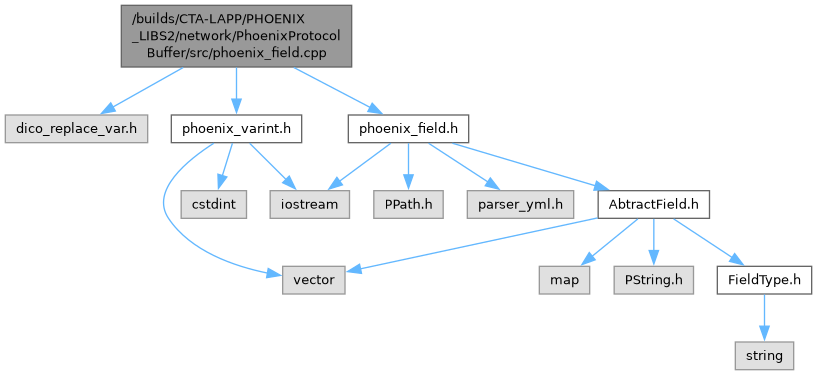
 Include dependency graph for phoenix_field.cpp:
Go to the source code of this file.
Functions | |
| FieldConfig | phoenix_createField (FieldType::FieldType type, size_t id, const PString &name, bool isArray) |
| Create a FieldConfig. | |
| void | phoenix_field (size_t &fieldId, size_t &fieldType, char *&iter) |
| Reads a Field header. | |
| void | phoenix_fieldPrint (char *&iter, size_t fieldType, const char *message) |
| Print the current field. | |
| void | phoenix_fieldPrintArray (char *&iter, const char *message) |
| Print the current ByteArray. | |
| void | phoenix_fieldSkip (char *&iter, size_t fieldType) |
| Skip the current field. | |
| bool | phoenix_parseFieldConfig (FieldConfig &field, const DicoValue &dico) |
| Load a fieldConfig with a DicoValue (parsed yml file) | |
| bool | phoenix_parseFieldConfig (FieldConfig &field, const DicoValue &dico, const PString &fieldConfigKey) |
| Load a fieldConfig with a DicoValue (parsed yml file) | |
| bool | phoenix_parseFieldConfig (FieldConfig &field, const PPath &fileName, const PString &fieldConfigKey) |
| Parse a yml file and search for a field_config key. | |
| void | phoenix_printFieldMessage (const char *message, size_t nbByte) |
| Print the Fields in a message. | |
| void | phoenix_printFieldMessage (const char *message, size_t nbByte, size_t offset) |
| Print the Fields in a message. | |
| FieldConfig phoenix_createField | ( | FieldType::FieldType | type, |
| size_t | id, | ||
| const PString & | name, | ||
| bool | isArray ) |
Create a FieldConfig.
| type | : type of the field |
| id | : id of the field |
| name | : name of the field |
| isArray | : true if the field is an array |
Definition at line 89 of file phoenix_field.cpp.
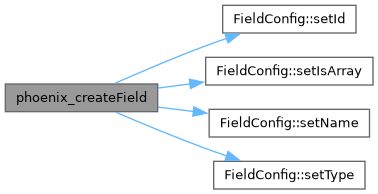
References FieldConfig::setId(), FieldConfig::setIsArray(), FieldConfig::setName(), and FieldConfig::setType().
Referenced by phoenix_parseFieldConfig().
Here is the call graph for this function: Here is the caller graph for this function:| void phoenix_field | ( | size_t & | fieldId, |
| size_t & | fieldType, | ||
| char *& | iter ) |
Reads a Field header.
| [out] | fieldId | : id of the current field |
| [out] | fieldType | : type of the current field |
| [out] | iter | : iterator ofer the message to be read |
Definition at line 16 of file phoenix_field.cpp.
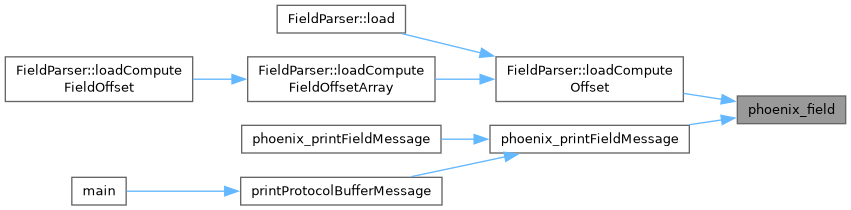
Referenced by FieldParser::loadComputeOffset(), and phoenix_printFieldMessage().
Here is the caller graph for this function:| void phoenix_fieldPrint | ( | char *& | iter, |
| size_t | fieldType, | ||
| const char * | message ) |
Print the current field.
| [out] | iter | : iterator of the current message to be read |
| fieldType | : type of the field to be skipped | |
| message | : message to be used |
Definition at line 62 of file phoenix_field.cpp.
References phoenix_fieldPrintArray(), phoenix_readValue(), and phoenix_readVarInt().
Referenced by phoenix_printFieldMessage().
Here is the call graph for this function: Here is the caller graph for this function:| void phoenix_fieldPrintArray | ( | char *& | iter, |
| const char * | message ) |
Print the current ByteArray.
| [out] | iter | : iterator of the current message to be read |
| message | : message to be used |
Definition at line 50 of file phoenix_field.cpp.
References phoenix_readVarInt().
Referenced by phoenix_fieldPrint().
Here is the call graph for this function: Here is the caller graph for this function:| void phoenix_fieldSkip | ( | char *& | iter, |
| size_t | fieldType ) |
Skip the current field.
| [out] | iter | : iterator of the current message to be read |
| fieldType | : type of the field to be skipped |
Definition at line 27 of file phoenix_field.cpp.
References phoenix_readVarInt(), and phoenix_skipVarInt().
Referenced by FieldParser::loadComputeOffset().
Here is the call graph for this function: Here is the caller graph for this function:| bool phoenix_parseFieldConfig | ( | FieldConfig & | field, |
| const DicoValue & | dico ) |
Load a fieldConfig with a DicoValue (parsed yml file)
| [out] | field | : fieldConfig to be initialised |
| dico | : DicoValue which contains the FieldConfig definition |
Definition at line 140 of file phoenix_field.cpp.
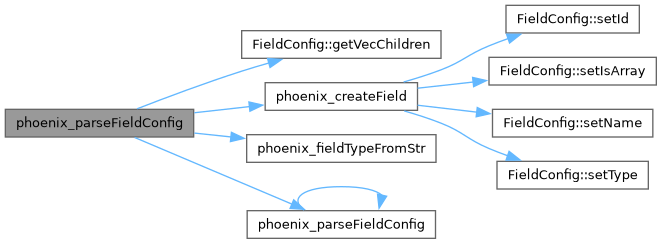
References FieldConfig::getVecChildren(), FieldType::NONE, phoenix_createField(), phoenix_fieldTypeFromStr(), phoenix_parseFieldConfig(), and FieldType::SUBMESSAGE.
Here is the call graph for this function:| bool phoenix_parseFieldConfig | ( | FieldConfig & | field, |
| const DicoValue & | dico, | ||
| const PString & | fieldConfigKey ) |
Load a fieldConfig with a DicoValue (parsed yml file)
| [out] | field | : fieldConfig to be initialised |
| dico | : DicoValue which contains the FieldConfig definition | |
| fieldConfigKey | : name of the key to be searched in the yml file to initialise the FieldConfig |
Definition at line 125 of file phoenix_field.cpp.
References phoenix_parseFieldConfig().
Here is the call graph for this function:| bool phoenix_parseFieldConfig | ( | FieldConfig & | field, |
| const PPath & | fileName, | ||
| const PString & | fieldConfigKey ) |
Parse a yml file and search for a field_config key.
| [out] | field | : fieldConfig to be initialised |
| fileName | : name of the yml file to be loaded | |
| fieldConfigKey | : name of the key to be searched in the yml file to initialise the FieldConfig |
Definition at line 104 of file phoenix_field.cpp.
References phoenix_parseFieldConfig().
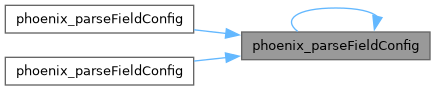
Referenced by phoenix_parseFieldConfig(), phoenix_parseFieldConfig(), and phoenix_parseFieldConfig().
Here is the call graph for this function: Here is the caller graph for this function:| void phoenix_printFieldMessage | ( | const char * | message, |
| size_t | nbByte ) |
Print the Fields in a message.
| message | : message to be used |
| nbByte | : number of bytes of the message |
Definition at line 198 of file phoenix_field.cpp.
References phoenix_printFieldMessage().
Here is the call graph for this function:| void phoenix_printFieldMessage | ( | const char * | message, |
| size_t | nbByte, | ||
| size_t | offset ) |
Print the Fields in a message.
| message | : message to be used |
| nbByte | : number of bytes of the message |
| offset | : offset to start reading the message |
Definition at line 180 of file phoenix_field.cpp.
References phoenix_field(), and phoenix_fieldPrint().
Referenced by phoenix_printFieldMessage(), and printProtocolBufferMessage().
Here is the call graph for this function: Here is the caller graph for this function: 1.13.2